Search
Search all editorial content on the website of the Storting.

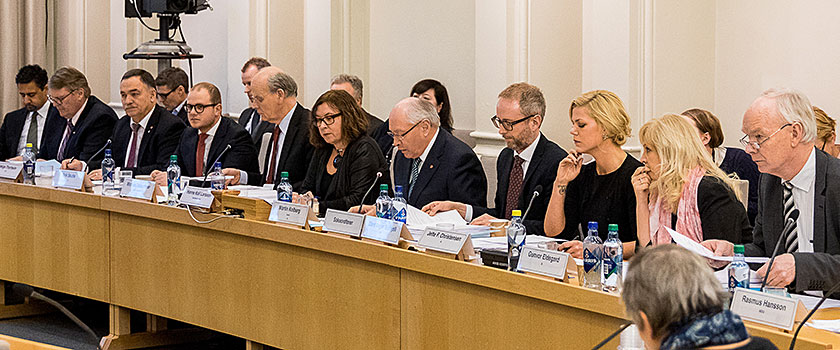
The Committee on Scrutiny and Constitutional Affairs performing an inquiry. Photo: Stortinget/Morten Brakestad.
One of the main functions of the Storting is to supervise the Government and the public administration.
he Constitution assigns a number of supervisory functions to the Storting, including
However, perhaps the most important duty is the political accountability of the Government towards the Storting. If the Storting by a formal vote expresses a lack of confidence in the Government, the Cabinet must submit a formal application to resign.
The substantial supervision which the Storting exercises over the public administration is based on different sources of information. It may be reports from one of the Storting’s independent supervisory bodies, such as the National Audit Office of Norway or the Parliamentary Ombud, or it may be matters communicated through the mass media which may be looked into by the Committee on Scrutiny and Constitutional Affairs.
The Committee on Scrutiny and Constitutional Affairs, which is one of the Storting's 12 standing committees, reviews and makes recommendations to the Storting on matters concerning supervision of the Government and the public administration. Reports from the National Audit Office of Norway (see below) constitute the bulk of the workload, of which reports on performance audit are most frequent. The Committee also examines reports from the Government, such as the Records of the Council of State.
Furthermore, the Committee on Scrutiny and Constitutional Affairs is distinguished from the other standing committees by the fact that it can act on its own initiative when dealing with supervisory matters. The Committee is entitled to perform any inquiry into the public administration it finds necessary for the exercise of the Storting's supervisory power. As a rule, the other standing committees in the Storting may only deal with matters of business referred to them by the Storting. Other committees may also on occasion deal with supervisory matters that are referred to them by the Storting. For example, the Committee on Foreign Affairs and Defence reviews the annual report on treaties and agreements concluded with foreign powers.
The Committee on Scrutiny and Constitutional Affairs also deals with matters concerning constitutional responsibility. The Committee is empowered to initiate inquiries that may lead to an impeachment process against a Member of the Storting or the Government, or a Supreme Court judge.
In addition to supervisory issues, the committee also deals with constitutional matters, appropriations to the Storting and the Royal Household, and election legislation.
Questions and interpellations addressed to the members of the Government provide an opportunity for the elected Members of the Storting to obtain information on specific matters and to ascertain the views of the ministers on specific political issues. Although government ministers are entitled to refuse to answer questions, as a rule all questions are answered. In fact, the government ministries make a great effort to enable ministers to do this.
Question Time is generally held in the Storting every Wednesday morning at ten o’clock; first Oral Question Time and then Ordinary Question Time.
During Oral Question Time, members of the Government answer brief questions put to them orally by Members of the Storting. On Monday of the same week, the Prime Minister will have informed the President of the Storting which members of the Government will take part, and the President will then have notified the Members of this. Normally, two members of Government take part every week. The exception is when the Prime Minister appears, which is approximately once a month. Usually Oral Question Time lasts for a little more than one hour. It is popular with the Members of the Storting, and the opposition makes frequent use of it.
During Ordinary Question Time, members of the Government answer questions that have been submitted in writing by the Members. Questions must be brief, and generally refer to specific issues. They often deal with matters of local concern that the media have focused attention on.
A Member who wishes to have a written answer to a question put to a member of the Government submits the question in writing to the President of the Storting, through the Storting’s administration, with an endorsement stating that a written answer is requested. Questions should be brief and must be signed personally by the questioner. The President should reject questions concerning matters that are outside the sphere of responsibility of the Government. The Storting’s administration ensures that the questions and answers are published on the Storting’s website. They are also printed in the official report on Storting proceedings.
Questions to be answered in writing are increasingly popular with the Members, and the number of questions has gone up substantially over the last few years.
Interpellations are a more elaborate way of presenting questions. An interpellation must be brief and filed in writing. Compared with questions for Question Time, interpellations generally deal with matters of greater scope and political importance, and generally lead to debates. The President may reject interpellations if the same matter is currently being or has been dealt with by a standing committee and has yet to be deliberated by the Storting. The President may also reject interpellations concerning matters on which interpellations or questions have already been submitted but not yet answered. The same applies to matters that fall outside the sphere of responsibility of the Government. The two last reasons for rejection mentioned also apply to Questions.
In the ensuing debate, both the interpellator and the member of the Government are first entitled to make one brief speech. Following that, other Members may speak briefly once each. Finally, the interpellator and the member of the Government are each entitled to make short remarks.
The Constitution provides that the Storting should appoint five national auditors who annually examine the State Accounts. The National Audit Office of Norway is the Storting's most important supervisory body, examining the activities of the national administration to ensure that State assets are utilized and managed according to sound financial principles and in keeping with the decisions and intentions of the Storting.
The National Audit Office of Norway is independent of the Government and other administrative bodies. The five national auditors appointed by the Storting jointly head the National Audit Office. The Storting makes the final decision on approval of the State Accounts after the National Audit Office has submitted its annotations and proposals.
Read more about the National Audit Office of Norway
The Parliamentary Ombud is appointed by the Storting for a term of four years, beginning 1 January the year after a general election.
The duty of the Ombud is to ensure that individuals do not suffer injustice at the hands of the public administration (national, county or municipal). A court action is costly and time-consuming, so by taking a complaint to the Ombud, an aggrieved person may obtain a decision through a much easier process. The Ombud examines the case and makes a statement. If it is found that a government action or decision is in violation of the law or is manifestly unreasonable, the agency or official in question will normally reconsider the matter and follow the recommendations of the Ombud.
If the Ombud finds reason to do so, he or she may initiate a thorough investigation of administrative proceedings, decisions or other matters.
The Ombudsman Act of 1962 provides that the Ombud must send an annual report to the Storting on his activities, giving, among other things, an account of the proceedings in cases of general interest. If the Ombud becomes aware of negligence or errors of major significance or scope, he or she may submit a special report to the Storting and to the appropriate administrative agency.
Read more about the Parliamentary Ombud
The aim and mandate of the Parliamentary Ombud’s Committee for the Norwegian Armed Forces (formerly the Parliamentary Ombudsman for the Norwegian Armed Forces) is to promote and protect the rights and interests of the personnel who are serving or have served in the Norwegian Armed Forces. The Ombud’s Committee has also been charged with helping to streamline the Armed Forces. The Committee consists of seven members, and is headed by the Parliamentary Ombud for the Armed Forces (formerly the Ombudsman for the Armed Forces).
The Ombud’s Committee submits annual reports to the Storting. In addition, it may initiate action, and may at any time report to the Storting. The Ombud’s Committee acts as an adviser to the Storting and the Ministry of Defence on matters within its sphere of competence, and carries out inspections of Norwegian military units home and abroad.
Read more about The Parliamentary Ombud’s Committee for the Norwegian Armed Forces
The EOS Committee – the Parliament Appointed Committee for Intelligence Oversight is a permanent committee consisting of seven members who monitor the Police Security Service, the Defence Security Service and Military Intelligence. The members of the Committee are elected by the Storting for a period of 5 years.
The Committee is responsible for continuous supervision of the work of the above-mentioned services, and investigates complaints. It also initiates its own issues where appropriate. The main aim of this Committee is to protect the security of the individual citizen. The Committee reports annually to the Storting.
Read more about the The EOS Committee
The primary function of the Norwegian National Human Rights Institution is to promote and protect human rights in accordance with the Constitution, the Human Rights Act and other legislation, international treaties and other international law. The national institution shall contribute to strengthening the implementation of human rights, in particular by:
The national institution shall not hear individual cases concerning violations of human rights.
The national institution shall submit an annual report to the Storting on the institution's activities and on developments in the human rights situation in Norway.
Read more about the Norwegian National Human Rights Institution